深度学习库——Tensorflow
关于 TensorFlow
TensorFlow™ 是一个采用数据流图(data flow graphs),用于数值计算的开源软件库。节点(Nodes)在图中表示数学操作,图中的线(edges)则表示在节点间相互联系的多维数据数组,即张量(tensor)。它灵活的架构让你可以在多种平台上展开计算,例如台式计算机中的一个或多个CPU(或GPU),服务器,移动设备等等。TensorFlow 最初由Google大脑小组(隶属于Google机器智能研究机构)的研究员和工程师们开发出来,用于机器学习和深度神经网络方面的研究,但这个系统的通用性使其也可广泛用于其他计算领域。
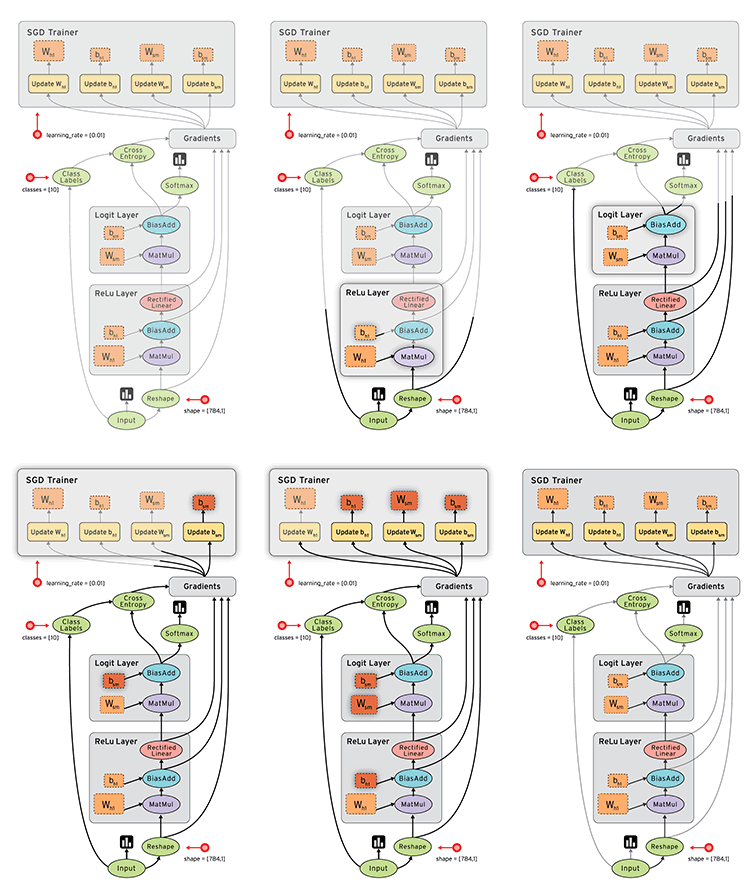
基础
Hello, Tensor World!
基本使用
使用 TensorFlow, 你必须明白 TensorFlow:
- 使用图 (graph) 来表示计算任务.
- 在被称之为 会话 (Session) 的上下文 (context) 中执行图.
- 使用 tensor 表示数据.
- 通过 变量 (Variable) 维护状态.
- 使用 feed 和 fetch 可以为任意的操作(arbitrary operation) 赋值或者从其中获取数据.
1. tf.constant 常量和session
import tensorflow as tf

# Create TensorFlow object called tensor
hello_constant = tf.constant('Hello World!')

with tf.Session() as sess:
    # Run the tf.constant operation in the session
    output = sess.run(hello_constant)
    print(output)
2. 输入
使用tf.placeholder()创建一个占位符,然后使用tf.session.run()中到feed_dict 参数将数据传入
import tensorflow as tf

output = None
x = tf.placeholder(tf.int32)

with tf.Session() as sess:
    output = sess.run(x,feed_dict = {x:12})
    print(output)
3. 数学运算
x = tf.add(5, 2)  # 7
x = tf.subtract(10, 4) # 6
y = tf.multiply(2, 5)  # 10
z = tf.divide(10,2) # 5
4. 类型转换
tf.subtract(tf.cast(tf.constant(2.0), tf.int32), tf.constant(1)) # 1
5. tf.Variable()
x = tf.Variable(5)
Training Your Classifier
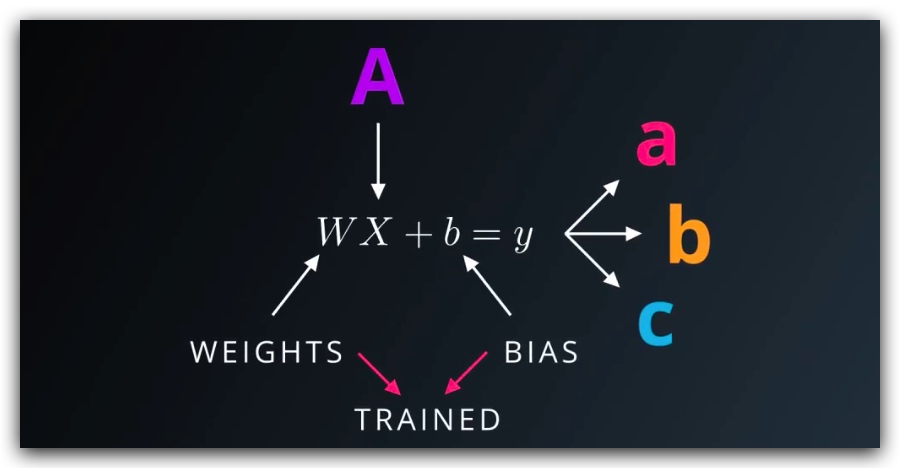
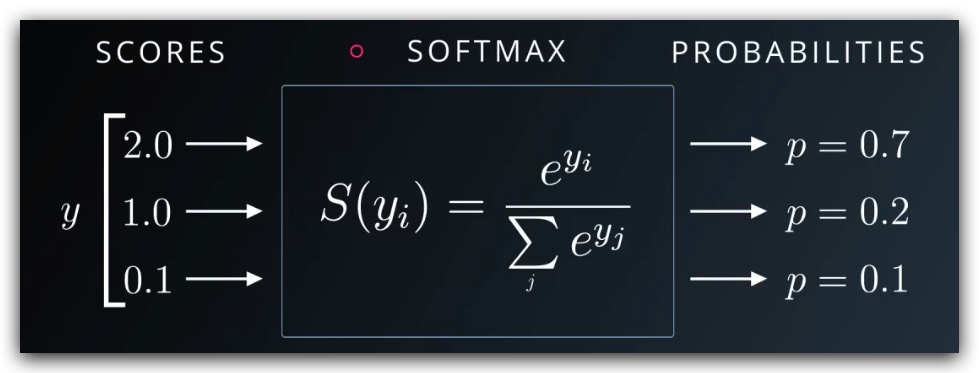
- 首先我们会训练模型,以确定权重W和偏差b的取值,然后利用W和b求解预测值y(logit)
- 然后,使用softmax函数,将预测值y转换成对应的概率p
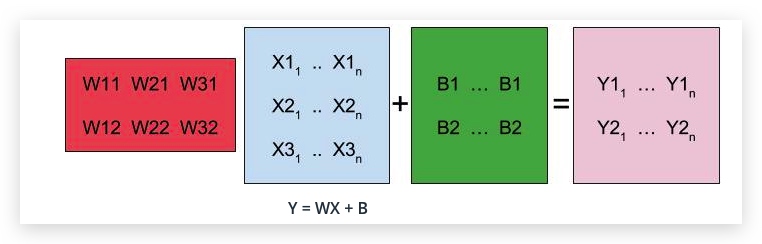
1. TensorFlow 线性方程


tf.global_variables_initializer()tf.truncated_normal()
# Quiz Solution
import tensorflow as tf
def get_weights(n_features, n_labels):
    return tf.Variable(tf.truncated_normal((n_features, n_labels)))

def get_biases(n_labels):
    return tf.Variable(tf.zeros(n_labels))

def linear(input, w, b):
    return tf.add(tf.matmul(input, w), b)
2. Softmax
def softmax(x):
    """Compute softmax values for each sets of scores in x."""
    return np.exp(x) / np.sum(np.exp(x), axis=0)

logits = [3.0, 1.0, 0.2]
print(softmax(logits))
x = tf.nn.softmax([2.0, 1.0, 0.2])
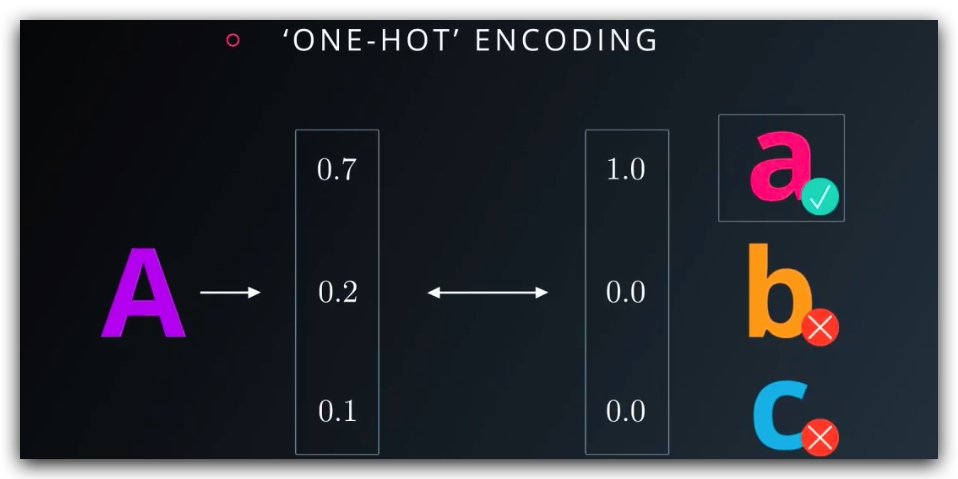
3. one-hot encoding
4. 交叉熵
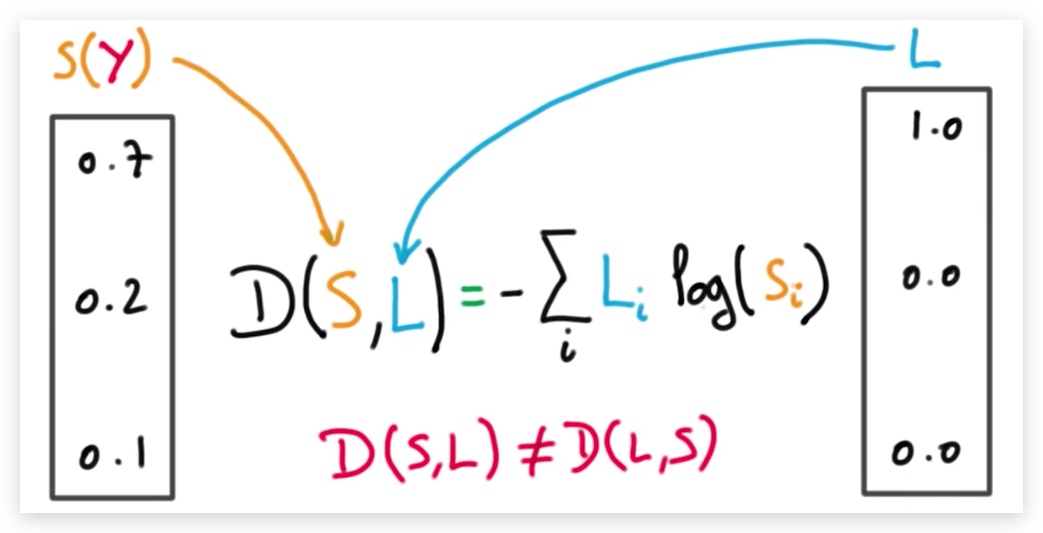
求logits和对应label的交叉熵,表示误差值。
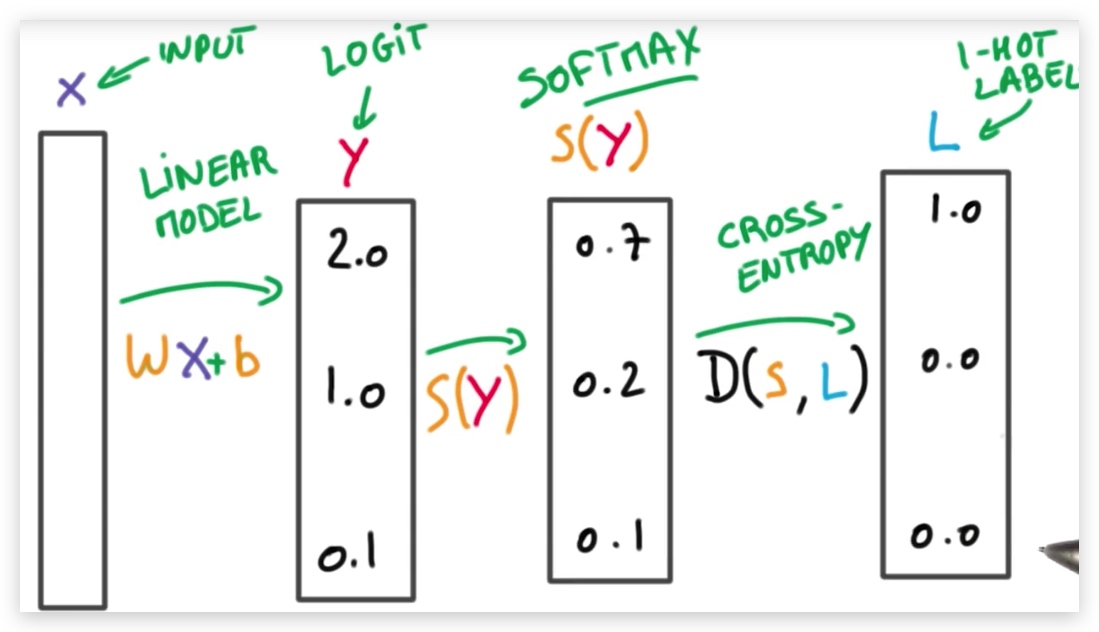
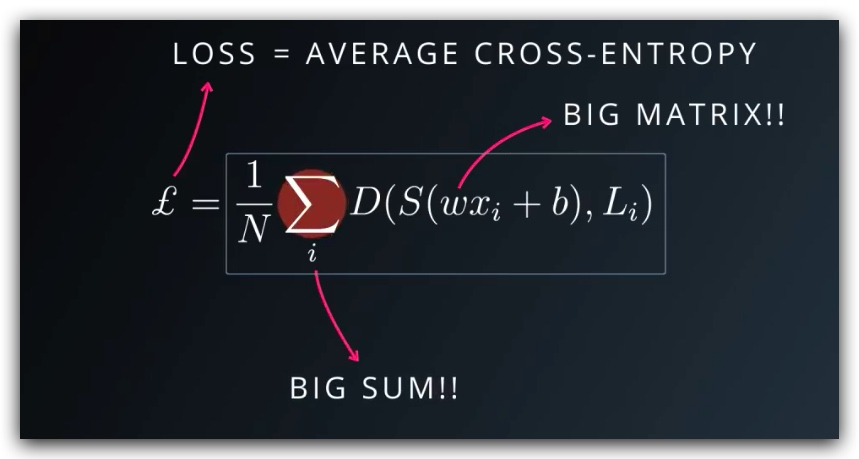 我们通过训练来找到w和b,在这个过程中,我们需要不断缩小loss,即使用梯度下降的方法,缩小误差函数(交叉熵)
5. 归一化输入及初始权重
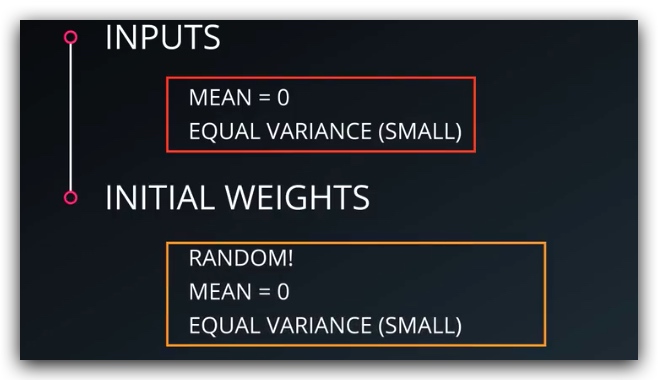
输入的变量为了便于优化器工作,要尽可能保证均值为0,且方差不变。
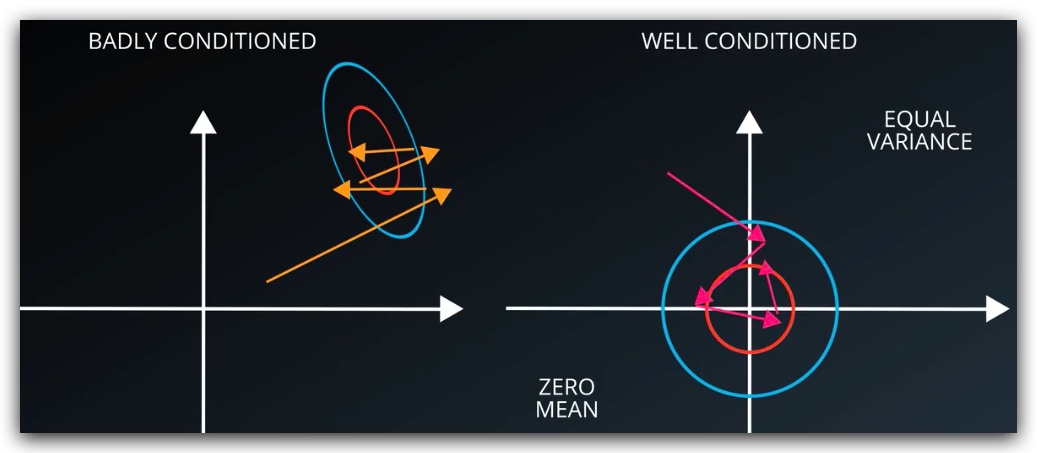 )
对于图像来讲,可以使用下面的方法处理输入的每个像素。
$
X'=a+{\frac {\left(X-X_{\min }\right)\left(b-a\right)}{X_{\max }-X_{\min }}}
$
)
对于图像来讲,可以使用下面的方法处理输入的每个像素。
$
X'=a+{\frac {\left(X-X_{\min }\right)\left(b-a\right)}{X_{\max }-X_{\min }}}
$
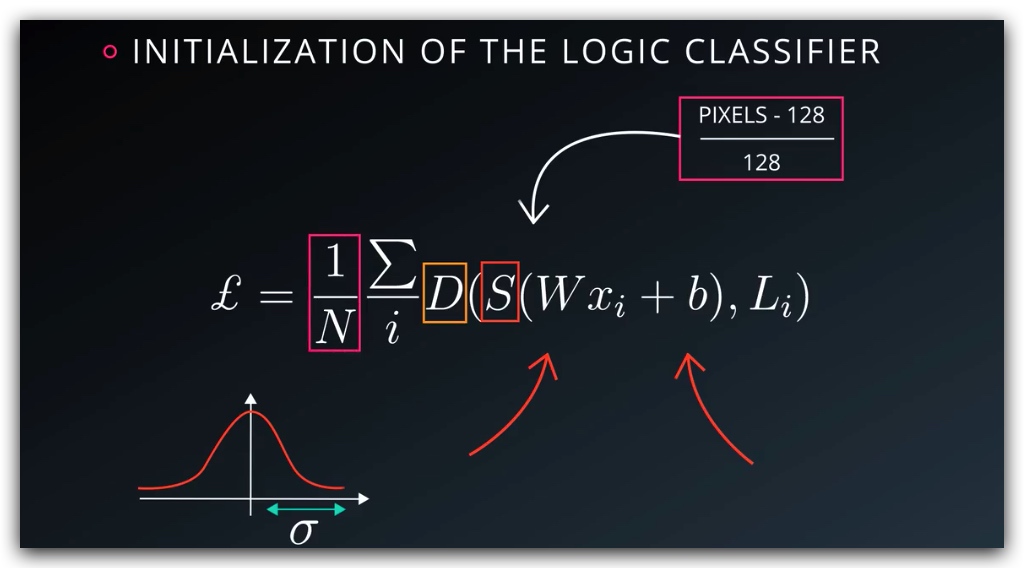
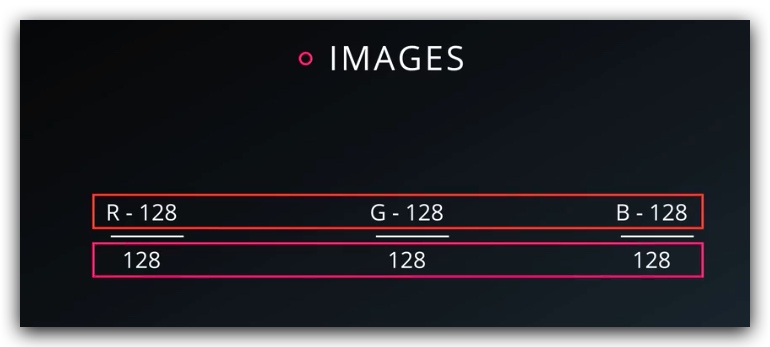 对于权重和偏差,最好从正态分布中取值,也要保证均值相同,方差不变(尽量小一些的sigma)
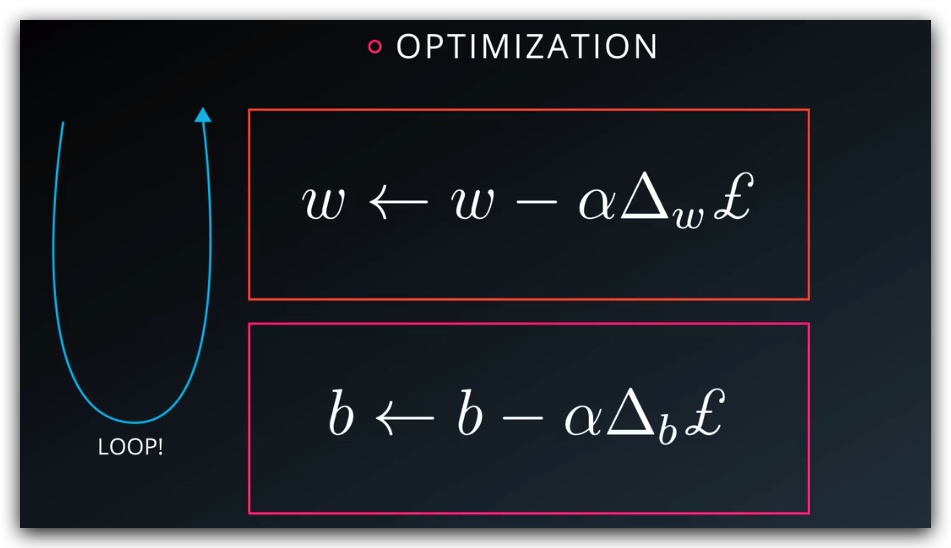
 反向求导,进行优化
6. 性能度量
- 训练数据集
- 验证数据集
- 测试数据集
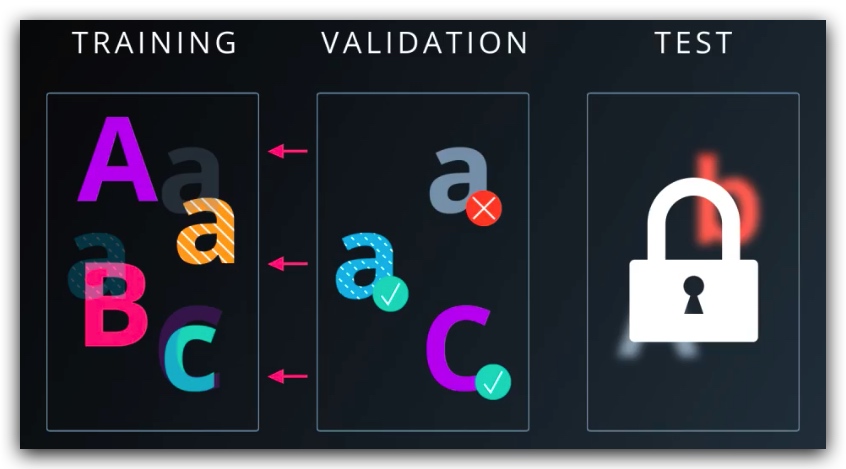
必须要单独隔离一部分的test数据,因为在调参过程中,我们会无意识的泄露验证集中的信息,导致测试数据不准确。
对于验证数据集和测试集的大小,自然是越大越好,当你调整的参数,使的有至少30个结果较之前有了变化,在统计学上才是有意义的。如果你有3000个数据,那么准确率必须提高或者降低0.1%,才是有意义的变化。因此一般来讲,我们需要至少30000个数据,来保证0.1%的精度。
此外,如果数据不均衡,例如某种类型的数据比例失衡,则不能使用该方法,我们需要增大数据集。比如使用交叉验证或直接获取数据
7. 随机梯度下降法(SGD)
求解loss函数的导数,大约是求解loss的三倍计算量,当数据集很大时,运算量会变的很大。 因此我们需要一个办法来减少运算量,此处使用一种相对比较简单的方法,随机梯度下降。
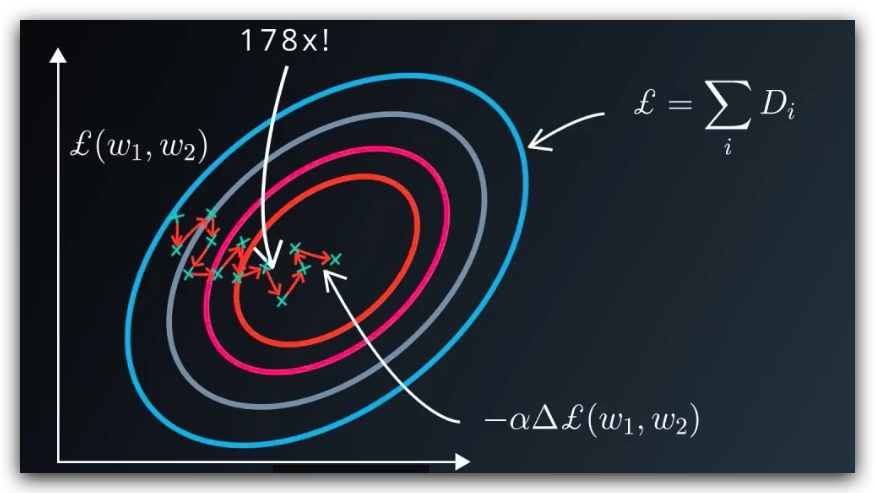
我们取一小部分的数据,计算它的导数,假定它时按照梯度下降的方向进行的,然后用它对参数进行更新(有时并不是下降),当随机次数足够多时,我们可以得到正确的结果。这种方法效率较高,但是有比较多的限制:
- 输入和权重初始值要遵循均值为0,方差不变且较小的要求
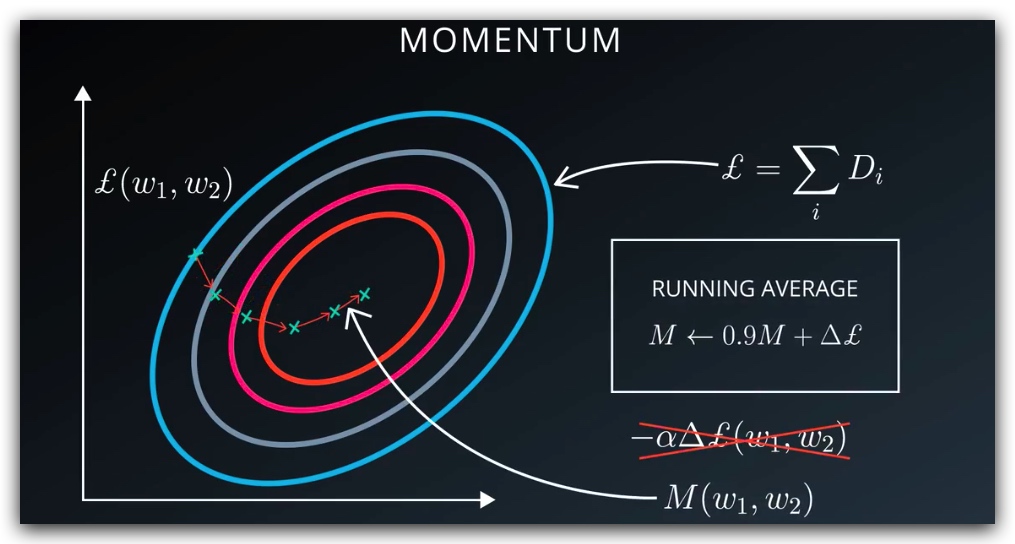
- 使用动量方法:使用梯度的实时平均值来更新权重,通常具有很好的收敛性
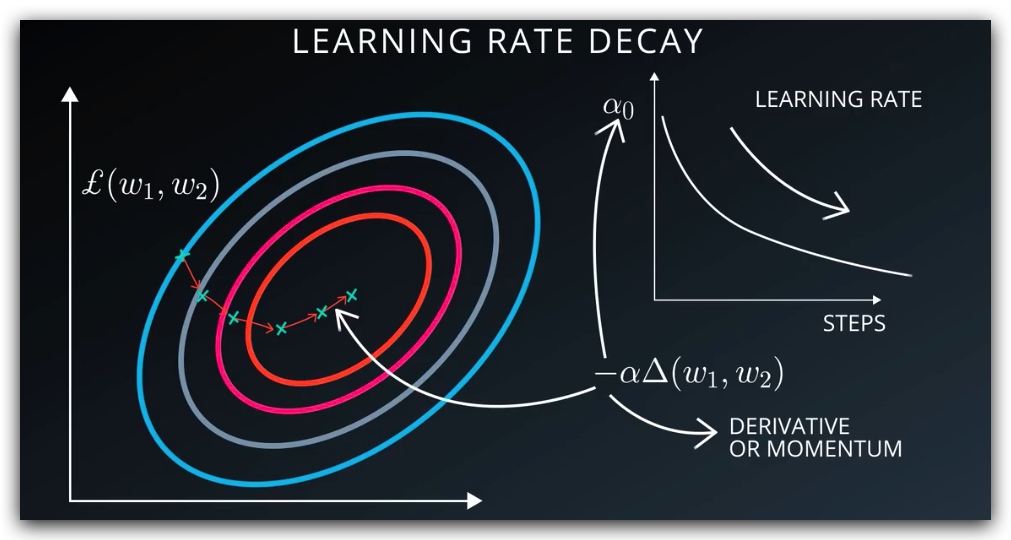
- 学习速率衰减:SGD可以有很多参数供我们调节,但是如果效果不好,请优先选择降低学习速率
8. Mini-batch 和 Epochs
- 我们可以取数据的子集来进行训练,称为batch,每次向模型输入batch_size大小的数据集
- 对我们的数据集进行一次feedforward和backforward,称之为一次Epochs。这个过程被用来不断提高模型的准确率。
- 通过调整
batch_size(小)、Epochs(多)和learn_rate(低)可以得到较好的准确率
from tensorflow.examples.tutorials.mnist import input_data
import tensorflow as tf
import numpy as np
from helper import batches  # Helper function created in Mini-batching section


def print_epoch_stats(epoch_i, sess, last_features, last_labels):
    """
    Print cost and validation accuracy of an epoch
    """
    current_cost = sess.run(
        cost,
        feed_dict={features: last_features, labels: last_labels})
    valid_accuracy = sess.run(
        accuracy,
        feed_dict={features: valid_features, labels: valid_labels})
    print('Epoch: {:<4} - Cost: {:<8.3} Valid Accuracy: {:<5.3}'.format(
        epoch_i,
        current_cost,
        valid_accuracy))

n_input = 784  # MNIST data input (img shape: 28*28)
n_classes = 10  # MNIST total classes (0-9 digits)

# Import MNIST data
mnist = input_data.read_data_sets('/datasets/ud730/mnist', one_hot=True)

# The features are already scaled and the data is shuffled
train_features = mnist.train.images
valid_features = mnist.validation.images
test_features = mnist.test.images

train_labels = mnist.train.labels.astype(np.float32)
valid_labels = mnist.validation.labels.astype(np.float32)
test_labels = mnist.test.labels.astype(np.float32)

# Features and Labels
features = tf.placeholder(tf.float32, [None, n_input])
labels = tf.placeholder(tf.float32, [None, n_classes])

# Weights & bias
weights = tf.Variable(tf.random_normal([n_input, n_classes]))
bias = tf.Variable(tf.random_normal([n_classes]))

# Logits - xW + b
logits = tf.add(tf.matmul(features, weights), bias)

# Define loss and optimizer
learning_rate = tf.placeholder(tf.float32)
cost = tf.reduce_mean(tf.nn.softmax_cross_entropy_with_logits(logits=logits, labels=labels))
optimizer = tf.train.GradientDescentOptimizer(learning_rate=learning_rate).minimize(cost)

# Calculate accuracy
correct_prediction = tf.equal(tf.argmax(logits, 1), tf.argmax(labels, 1))
accuracy = tf.reduce_mean(tf.cast(correct_prediction, tf.float32))

init = tf.global_variables_initializer()

batch_size = 128
epochs = 10
learn_rate = 0.001

train_batches = batches(batch_size, train_features, train_labels)

with tf.Session() as sess:
    sess.run(init)

    # Training cycle
    for epoch_i in range(epochs):

        # Loop over all batches
        for batch_features, batch_labels in train_batches:
            train_feed_dict = {
                features: batch_features,
                labels: batch_labels,
                learning_rate: learn_rate}
            sess.run(optimizer, feed_dict=train_feed_dict)

        # Print cost and validation accuracy of an epoch
        print_epoch_stats(epoch_i, sess, batch_features, batch_labels)

    # Calculate accuracy for test dataset
    test_accuracy = sess.run(
        accuracy,
        feed_dict={features: test_features, labels: test_labels})

print('Test Accuracy: {}'.format(test_accuracy))
9. Session
correct_prediction = tf.equal(tf.argmax(logits, 1), tf.argmax(one_hot_y, 1))
accuracy_operation = tf.reduce_mean(tf.cast(correct_prediction, tf.float32))
saver = tf.train.Saver()

def evaluate(X_data, y_data):
    num_examples = len(X_data)
    total_accuracy = 0
    sess = tf.get_default_session()
    for offset in range(0, num_examples, BATCH_SIZE):
        batch_x, batch_y = X_data[offset:offset+BATCH_SIZE], y_data[offset:offset+BATCH_SIZE]
        accuracy = sess.run(accuracy_operation, feed_dict={x: batch_x, y: batch_y, keep_prob: 1.0})
        total_accuracy += (accuracy * len(batch_x))
    return total_accuracy / num_examples
session.run()来启动一次运算,